
GEO vs SEO in e-commerce: what is the difference, and what changes for a store?
All marketsBy SushmitaUpdated
SEO gets your store’s page listed in search results so a shopper clicks it. GEO gets your store named in the answer an AI assistant such as ChatGPT or Gemini writes. For an online store they share most of the work: readable pages, clear product facts, structured data and a good reputation elsewhere. GEO changes how you write (facts an assistant can quote), what you count (mentions as well as clicks) and how much other sites’ opinions matter.
In short
- SEO wins a position and a click. GEO wins a mention in a written answer.
- Most of the work is shared: readable pages, one page per need, structured data, reviews.
- GEO rewards plain, specific facts and direct answers to full questions.
- A store that ranks for nothing should start with SEO and write those pages to be quotable.
- Count branded searches and direct visits too. Not every AI mention produces a click.
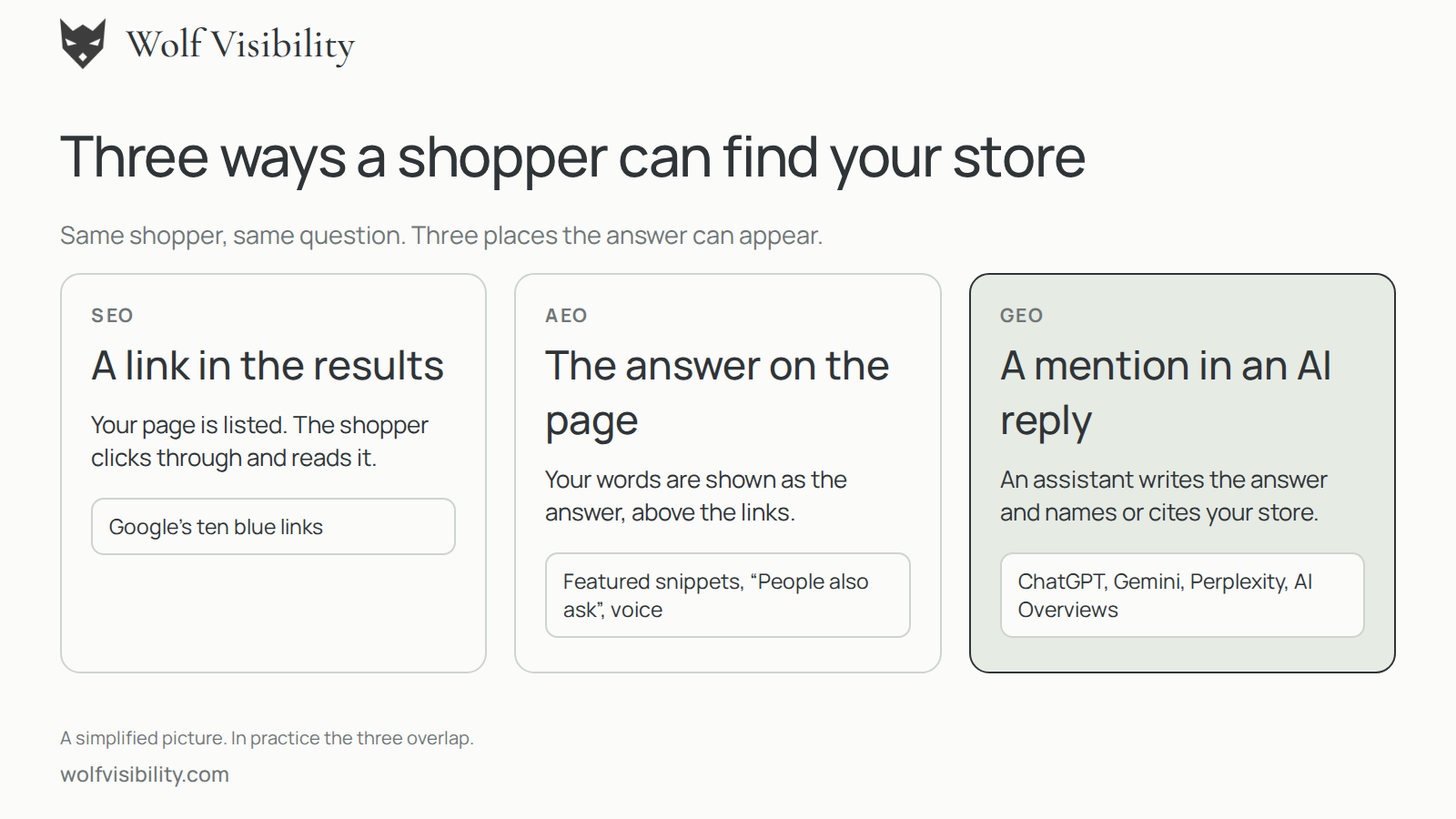
What is the difference between GEO and SEO?
SEO, search engine optimisation, is the work of getting your page listed high in search results so that a shopper clicks it. GEO, generative engine optimisation, is the work of getting your store named in the answer an AI assistant writes, whether or not the shopper clicks anything.
The shopper’s question is the same. What differs is who reads your page first: with SEO a person scans a list and chooses, and with GEO a machine reads several pages, writes one answer and decides which names to include.
| SEO | GEO | |
|---|---|---|
| Where you appear | The list of links in Google or Bing | The written answer in ChatGPT, Gemini, Perplexity or Google’s AI answers |
| What you win | A position and a click | A mention, sometimes with a link |
| What the shopper types | A few words: “gold hoop earrings” | A full question: “which gold hoops won’t irritate sensitive ears?” |
| What gets used | Your whole page, as one result | A sentence or a fact taken from your page |
| What builds trust | Links from other sites | Being described the same way in many places |
| How you measure it | Rankings, clicks, sales from search | Whether you are named, how accurately, and visits from assistants |
| How stable it is | Positions move slowly | The same question can give a different answer tomorrow |
What stays the same for an online store?
More than the acronyms suggest. Assistants that search the web begin with ordinary search results, then read the pages. A product page that is clear, fast, specific and well reviewed is good for both.
- Pages a crawler can read. Text in the page, not locked inside images or scripts.
- One page per buyer need. A collection for “hypoallergenic gold earrings” serves the search and the question.
- Product structured data. Price, stock and reviews in a form machines read without guessing.
- A reputation outside your own site. Reviews and mentions help rankings and help assistants trust you.
If those four are in place, a store has done most of GEO already.
What actually changes?
- Facts beat adjectives. An assistant quotes “18k gold vermeil, 2.5 microns, nickel-free”. It has no use for “effortlessly elegant”. Product copy written to be quoted is plainer than copy written to charm.
- Questions get longer. People ask assistants in sentences. Pages that answer a specific question directly, in the first two lines under a heading, are the ones that get lifted.
- Other sites matter more. In search, a forum thread about your product is a competitor for the click. In an AI answer, it is a source that can put your name in the reply. Publishing on trusted sites on purpose has a name, parasite SEO, and some versions of it break Google’s rules.
- A click is no longer the only result. A shopper may read the answer, remember your name and search for you later. That sale shows up as a branded search or a direct visit.
- Crawler access is a decision. AI crawlers are separate from Google’s, and some security settings block them by default.
How much attention does GEO deserve today?
Enough to do the cheap things now. In October 2026 we read 24 Google first pages for three products: sunscreen in India, and creatine gummies and magnesium glycinate in the United States. 23 of them had an AI-written answer above the ordinary results. It is a small sample, but on those pages the AI answer was the first thing a shopper saw.
Underneath that answer, the ordinary results are still where most stores are found. In our October 2026 study of shopping searches across 23 e-commerce verticals, stores held 55% of first-page results.
So the two are not rivals for the same budget. A sensible split for a small store:
| If your store… | Put most effort into | And do this for the other |
|---|---|---|
| Ranks for nothing yet | SEO: product and collection pages for searches you can win | Write those pages in plain facts, so they are quotable from day one |
| Ranks for some buying searches | Both: add buyer questions and structured data to the pages that rank | Check monthly what assistants say about your category |
| Is well known in its niche | GEO: reviews, mentions, accurate facts everywhere you are listed | Keep the pages that rank up to date |
If you are choosing your first searches, our guide to e-commerce keyword research shows how, and GEO for e-commerce has the seven steps in order.
Common questions
Is GEO replacing SEO?
No. Assistants that search the web start from search results, so pages that rank are the ones most often cited. GEO sits on top of SEO. A store that stops doing SEO usually loses both.
Is GEO just SEO with a new name?
Most of it is the same work. The real additions are writing facts so a machine can quote them, checking that AI crawlers can read your pages, and paying attention to how your brand is described on other sites.
Which should a new online store do first?
SEO, on the product and collection pages for searches a small store can win. Write those pages in plain, specific sentences and you have done the first part of GEO at no extra cost.
Does ranking first in Google mean ChatGPT will mention me?
It helps and it is not a guarantee. Assistants read several results and prefer pages with clear facts and brands that other sources also mention. A lower-ranked page with a direct answer is sometimes the one quoted.
Do keywords still matter for GEO?
Yes, as topics more than exact phrases. Use the words buyers use, and answer the question behind them. Assistants match meaning, so a page about “nickel-free earrings” can serve a question about “earrings for sensitive ears”.
How do I measure GEO if there is no ranking?
Ask a fixed list of buyer questions each month and record whether you are named, whether the facts are right and what is cited. Track visits referred by assistants and searches for your brand name alongside it.
When this advice changes
- Your category gets few AI answers. Search your own products. If the results show no AI answer, the ordinary results deserve nearly all your effort for now.
- Shoppers mostly buy on marketplaces. Your listing there is the page both search engines and assistants read. Improve it before your own site.
- Your product needs explaining. Assistants are where people ask “what is” and “which one”. A clear explainer on your site earns mentions earlier than a product page.
- You rely on local customers. Keep your business profile, address and opening hours identical everywhere. Assistants repeat whichever version they find.
Note for your developer or agency: treat AI crawlers as a separate decision from Googlebot in robots.txt and in any bot-protection service; keep product facts in server-rendered HTML; and tag links you control so that visits from assistants can be told apart from other referrals in analytics.