
GEO for e-commerce: how to get your store mentioned in AI answers
All marketsBy SushmitaUpdated
GEO for e-commerce means making your store easy for AI assistants such as ChatGPT, Gemini and Perplexity to read, trust and mention when shoppers ask for a product. For a store it comes down to seven things: let AI crawlers reach your pages, state product facts in plain sentences, add structured data, keep a product feed current, answer buyers’ real questions, earn mentions on other sites, and check each month what the assistants say.
In short
- GEO is being named, correctly, in the answers AI assistants write for shoppers.
- In our October 2026 research, 23 of 24 Google first pages for three products carried an AI-written answer.
- Most of the work is ordinary product-page hygiene: readable pages, plain facts, structured data, a feed.
- Assistants lean on what other sites say about you, so reviews and honest mentions matter.
- Nobody can guarantee a place in an AI answer. Check what is said every month.
What is GEO, in plain words?
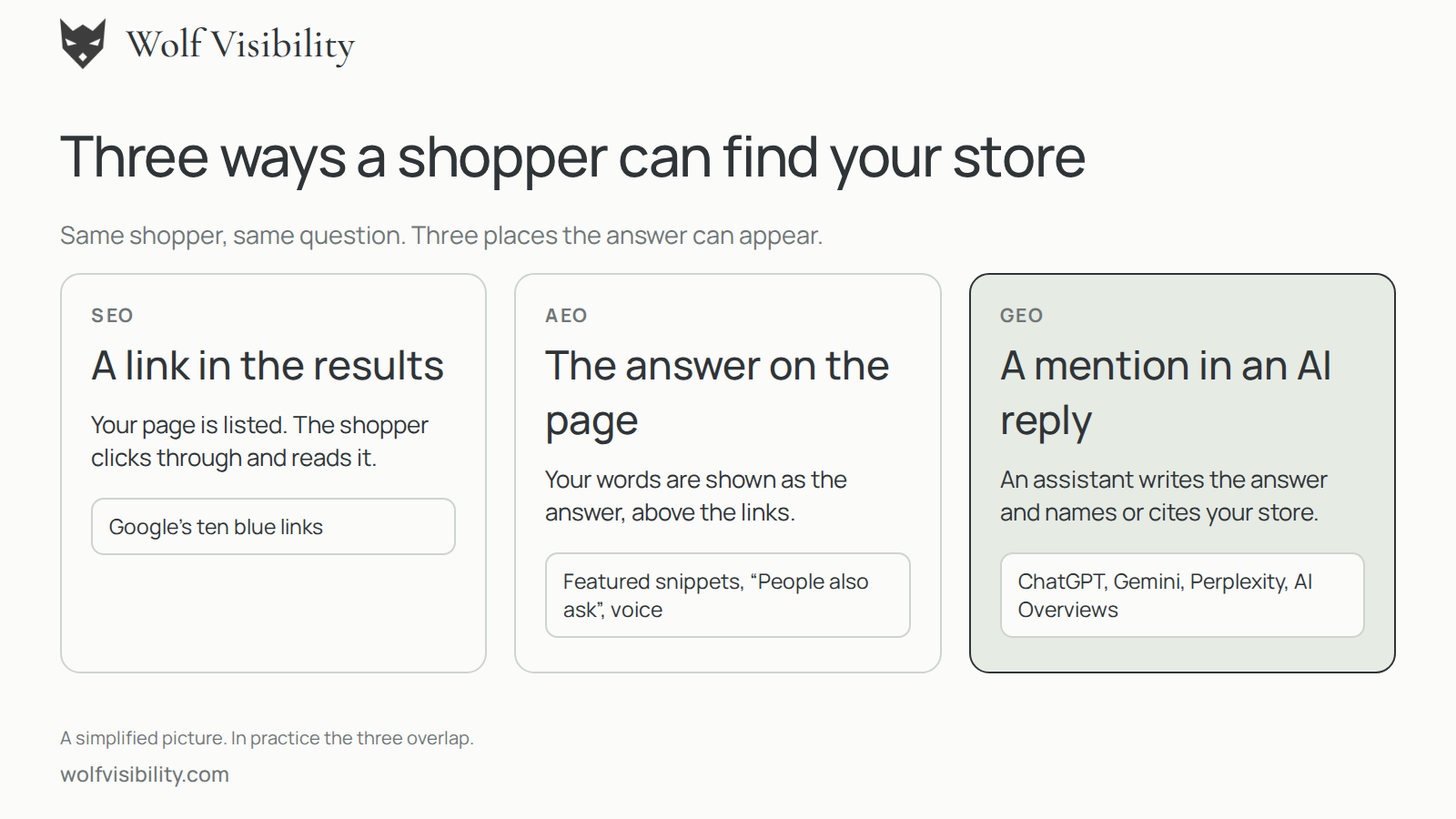
GEO stands for generative engine optimisation. A generative engine is an AI system that writes an answer instead of handing over a list of links: ChatGPT, Gemini, Perplexity, Copilot, and the AI answers Google now puts at the top of its results.
When a shopper asks one of them “what’s a good fragrance-free sunscreen for oily skin?”, the reply names a few products and sometimes links to where it read about them. GEO is the work of being one of those names, described correctly.
The term comes from a 2023 research paper by a group at Princeton, Georgia Tech, the Allen Institute for AI and IIT Delhi. In their tests, pages that added quotations, statistics and cited sources were shown up to about 40% more often in AI answers than the same pages without them.
Why should an online store care now?
Because the AI answer is already on the page your shoppers see. In October 2026 we read 24 Google first pages for three products: sunscreen in India, and creatine gummies and magnesium glycinate in the United States. 23 of the 24 had an AI-written answer above the ordinary results.
That is a small sample from three categories, not a market figure. It is enough to say that for shopping questions like these, the first thing a shopper reads is often written by an AI, and it mentions some brands and leaves out others.
Assistants have also started selling. ChatGPT, Perplexity and Google all show product listings inside answers, with prices and reviews, and some let the shopper buy without leaving the chat.
How does an assistant decide which stores to mention?
Nobody outside these companies knows the exact rules, and they differ between assistants. Three things are visible from the outside:
- It has to be able to read you. Assistants that search the web send their own crawlers. A page they cannot fetch, or cannot read without running scripts, does not exist for them.
- It prefers facts it can lift. A sentence such as “SPF 50, fragrance-free, 50 ml, ₹499” can be quoted. “Experience the glow” cannot.
- It listens to what others say about you. Replies lean on forums, reviews, buying guides and retailer listings. A store that is only described on its own website gives the assistant one source, and an interested one.
What should a store do first?
Seven things, in this order. The first four are also ordinary good SEO, which is why GEO is cheaper than it sounds for a store that has done the basics.
| Step | What to do | Why it matters to an assistant |
|---|---|---|
| 1. Let them in | Check that your site does not block AI crawlers, and that product details appear in the page’s source without scripts. | A blocked or empty page cannot be quoted. |
| 2. State the facts | On every product page: what it is, who it is for, size, materials or ingredients, price, delivery and returns, in plain sentences. | These are the details shoppers ask about. |
| 3. Mark them up | Add product structured data: name, price, availability, reviews, brand, identifiers. | It removes guesswork about price and stock. |
| 4. Send a feed | Keep a product feed current in Google Merchant Center, and in the merchant programmes the assistants run. | Shopping answers are built from feeds. |
| 5. Answer real questions | Add the questions buyers ask to the product or collection page, each with a direct two-sentence answer. | Assistants are asked in full questions. |
| 6. Be discussed elsewhere | Earn reviews, forum mentions and inclusion in honest buying guides. | Replies draw on third-party sources. |
| 7. Check what is said | Ask the assistants your buyers’ questions every month and note the answers. | You cannot fix what you have not read. |
Step 6 takes the longest. Our article on parasite SEO covers the honest and dishonest ways to appear on other people’s sites, and step 7 is covered in AI brand monitoring for e-commerce.
What does this look like for one product page?
Take a store selling a gold vermeil hoop earring. This is an illustration, not a measured result.
- Before. The page has a name, four photos, a price and a paragraph about “timeless elegance”. Materials are in an image. Reviews load only after scrolling.
- After. The first lines read: “18k gold vermeil over sterling silver, 2.5 microns. 20 mm hoop. Nickel-free, suitable for sensitive ears. Ships in two days; 30-day returns.” Below it are four buyer questions with short answers, and the reviews are in the page itself.
A shopper asking an assistant for “nickel-free gold hoops that won’t tarnish” has now been given, in the page’s own words, every fact that question needs.
What will GEO not do?
- It will not replace your own pages ranking. Assistants that search the web start from search results. A store that ranks nowhere is rarely cited.
- It cannot be guaranteed. The same question gives different answers on different days. Anyone promising a fixed position in ChatGPT is guessing.
- It is hard to measure in sales. Many shoppers read an AI answer and then search for the brand by name. Watch branded searches and direct visits as well as referrals.
Common questions
Is GEO different from SEO for an online store?
Mostly it is the same work with a different reader. Clear pages that rank also get quoted. GEO adds three things: making sure AI crawlers can read you, writing facts so they can be lifted, and caring more about what other sites say about you.
Do I need to change my Shopify or WooCommerce theme?
Usually not. Check that product details, price and reviews are in the page’s source, and that your theme outputs product structured data. Most current themes do. Apps that load reviews or descriptions with scripts are the common problem.
Should I block AI crawlers?
If you want to be mentioned, no. Some crawlers collect training data and others fetch pages to answer a live question, and they can be allowed separately in robots.txt. A store selling products has little to lose from being read.
Do I need an llms.txt file?
It does no harm and takes minutes, but no major assistant has said it relies on one. Spend the time on product facts and structured data first.
How long does GEO take to show results?
Assistants that search the web can pick up a changed page within days. Being recommended without a search depends on how widely your brand is discussed, which takes months.
How do I know whether it is working?
Ask the same set of buyer questions each month and record whether you are named, whether the details are right and which sources are cited. Also watch visits referred from assistants and searches for your brand name.
When this advice changes
- Your store is new and ranks for nothing. Start with your own product and collection pages. Assistants that search the web cite what search already finds.
- You sell through marketplaces as well. Assistants often cite the marketplace listing. Keep it as complete and accurate as your own product page.
- You sell in a regulated category. Health and finance answers lean hard on medical and official sources. State only what you can support, and cite it.
- Your catalogue changes daily. The feed matters most. A wrong price or an out-of-stock product in an AI answer costs more trust than no mention.
Note for your developer or agency: check robots.txt and any firewall rules for OAI-SearchBot, GPTBot, PerplexityBot, ClaudeBot and Google-Extended; render product name, price, availability and reviews on the server; output Product, Offer, AggregateRating and Organization structured data that matches the visible page; include GTIN or MPN where they exist; and keep the Merchant Center feed and the page in agreement on price and stock.