
AI brand monitoring for e-commerce: check what ChatGPT and Gemini say about your store
All marketsBy SushmitaUpdated
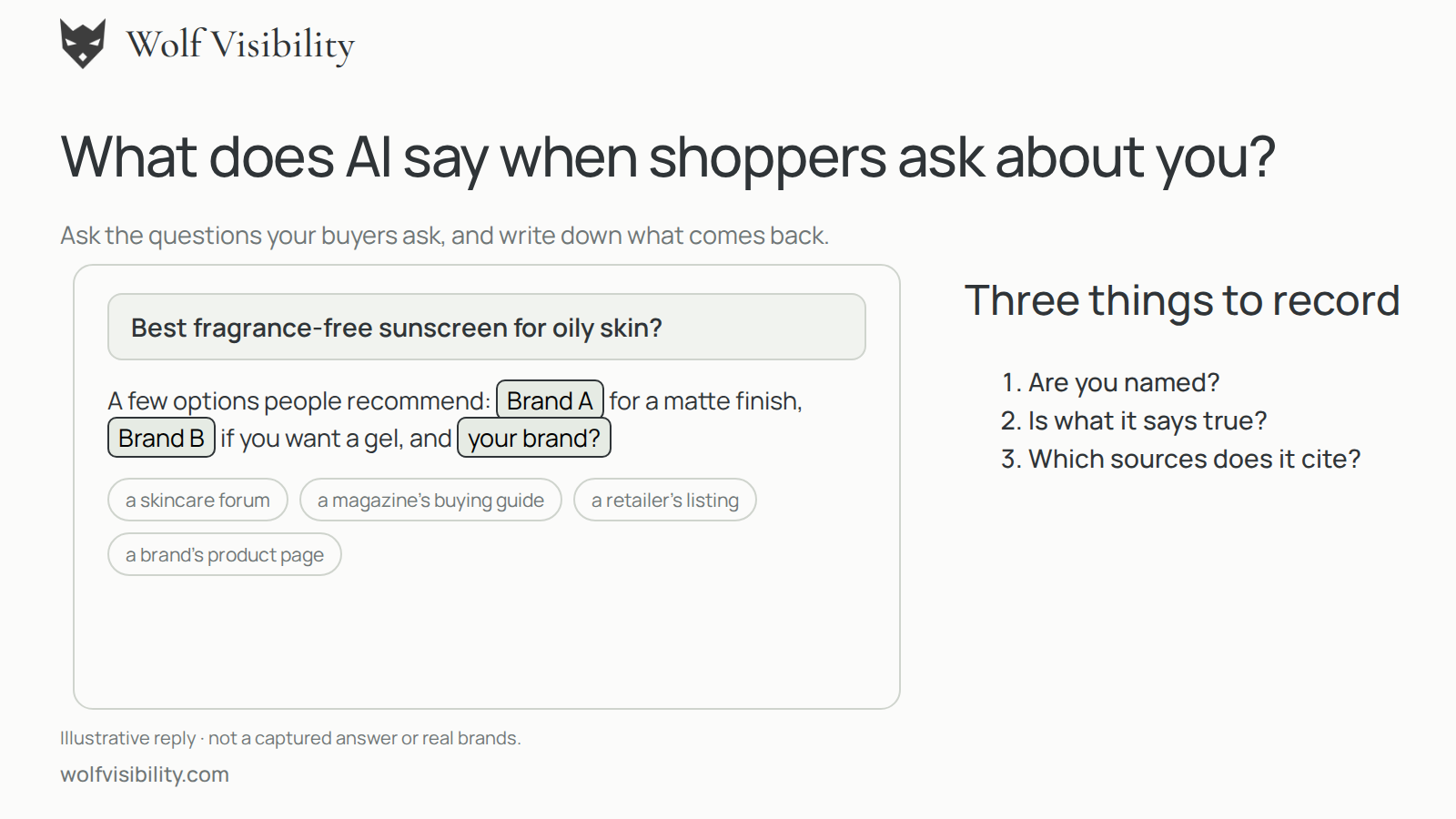
To find out whether AI shopping assistants mention your products, ask them the questions your buyers ask. Put twenty buyer questions to ChatGPT, Gemini, Perplexity and Google’s AI answers, and record whether your products are named, whether the facts are right and which sources are cited. Repeat it monthly, then fix the pages those answers come from. This is AI brand monitoring, and a store can do it for free.
In short
- Track three things: whether you are named, whether it is accurate, and which sources are cited.
- Twenty questions, four assistants, once a month, in a spreadsheet, is enough to start.
- Answers vary between runs, so ask more than once and report how often you appear.
- You cannot edit an AI answer. You fix the pages and listings it reads.
- Pay for a tool when you pass about fifty questions, several countries or weekly reporting.
What is AI brand monitoring?
It is checking, on a schedule, what AI assistants say when people ask about your products, your category and your brand. Ordinary brand monitoring watches news, reviews and social posts. This watches the answers written by ChatGPT, Gemini, Perplexity, Copilot and Google’s AI results.
For a store it answers three questions:
- Are we named? When a shopper asks for a product like ours, does the reply include us?
- Is it true? Are the price, ingredients, sizes, delivery and returns it states correct?
- Where did it get that? Which sites does the assistant cite, and are we on them?
Why does a small store need it?
Because an assistant can be wrong about you with complete confidence, and you will not be told. It may quote last year’s price, describe a product you have discontinued, or say you do not ship somewhere you do. A shopper who reads that does not visit your site to check.
It also shows you who is being recommended in your place, and from which sources. That is a list of the sites where your brand needs to appear.
How do you monitor AI answers without paying for a tool?
A spreadsheet and an hour a month are enough to start.
- Write twenty questions in your buyers’ words, in the four groups below.
- Ask each one in ChatGPT, Gemini, Perplexity and Google, in a fresh conversation, signed out or in a private window where you can, so your own history does not shape the reply.
- Record five things for each answer: whether you were named, where in the answer, what was said about you, whether it was correct, and which sources were cited.
- Ask twice. Answers vary from one run to the next. Two or three runs tell you whether a mention is steady or a matter of luck.
- Repeat monthly with the same questions, so you are comparing like with like.
| Group | What it tests | Example |
|---|---|---|
| Category | Whether you are recommended at all | “Best fragrance-free sunscreen for oily skin in India” |
| Comparison | How you are described next to rivals | “[Your brand] vs [a competitor] sunscreen” |
| Brand | Whether the facts about you are right | “Is [your brand] sunscreen safe for sensitive skin?” |
| Problem | Whether you appear before the shopper knows the product | “Why does my sunscreen leave a white cast?” |
What should you do with what you find?
| What you see | Likely cause | What to do |
|---|---|---|
| A wrong fact about your product | An old page, an outdated listing, or a detail that is missing from your site | Correct it on your own page and on every marketplace and directory listing, in the same words |
| You are not named for your category | Few sources outside your site describe you | Earn reviews, forum answers and inclusion in honest buying guides |
| A competitor is named, citing one guide | That guide is the assistant’s main source | Ask to be considered for it, with a sample and real details |
| You are named, with no link | The assistant knows the brand but did not read a page | Make sure the matching product page states the answer plainly |
| A discontinued product is described | The old page still exists or is still listed elsewhere | Redirect it to the replacement and update the feed |
Notice that none of these fixes happens inside the assistant. You cannot edit an AI answer. You change the pages it reads, and the answer follows, sometimes within days and sometimes not for months.
When is a paid tool worth it?
When the spreadsheet stops being practical: more than about fifty questions, several countries, or a team that needs a weekly report. Paid tools run the questions for you across assistants, repeat them to smooth out the variation, and chart how often you are mentioned against named competitors. Profound, Peec AI and Otterly are built for this, Surfer sells an AI Tracker add-on, and the large SEO suites such as Semrush and Ahrefs now include it.
Three things to check before paying:
- Which assistants and which countries it covers. An answer in the United States is often different from one in India.
- Whether it shows the sources cited. A mention count without sources tells you the score and not what to do.
- How it collects answers. Some tools query the models directly, which can differ from what a person sees in the app with web search switched on.
What are the limits?
- There is no ranking. A reply is written fresh each time. Report how often you appear across repeated runs, not a position.
- You see a sample. Twenty questions are not the thousands of ways shoppers ask. Treat results as a direction.
- Mentions are not sales. Pair the checks with visits referred from assistants and with searches for your brand name.
Monitoring tells you where you stand. Changing it is the subject of GEO for e-commerce, and the terms are untangled in SEO vs GEO vs AEO.
Common questions
How can I find out if AI shopping assistants mention our products?
Ask them. Write the questions your buyers ask, such as the best product in your category or your brand against a competitor, and put each one to ChatGPT, Gemini, Perplexity and Google in a fresh, signed-out session. Record whether your products are named, what is said and which sites are cited, ask twice because answers vary, and repeat monthly. There is no report that shows this for you; the assistants don’t publish what people ask.
What is AI brand monitoring?
It is the regular checking of what AI assistants say about your brand, products and category: whether you are mentioned, whether the details are correct, and which websites the assistant relied on.
Can I see how many people asked ChatGPT about my brand?
No. Assistants do not publish what people ask or how often. You can only test questions yourself, or use a tool that does the same at scale. Visits referred from assistants and searches for your brand name are the nearest measures of demand.
How often should a store check?
Monthly is enough for most. Check again after a price change, a product launch or a burst of reviews, since those are when answers go out of date.
What if an assistant says something false about my product?
Find where the wrong detail lives: an old page on your site, a marketplace listing, a review or an article. Correct what you control, ask for corrections where you do not, and state the right fact plainly on your product page. Most assistants also have a feedback button on the answer.
Which AI brand monitoring tool is best for a small store?
Start with the manual method. If you need a tool, choose on three points: it covers the assistants and countries your shoppers use, it shows the sources behind each answer, and it explains how the answers are collected.
Does being mentioned by AI increase sales?
It can, and it is hard to prove from one number. Shoppers often read an answer and search for the brand later. Look at assistant referrals, branded searches and direct visits together over a few months.
When this advice changes
- Your brand is new. Expect to be absent at first. Monitor category and problem questions to see which sources are cited, and aim to appear on those.
- Your brand name is a common word. Assistants may confuse you with something else. Add what you sell and where to brand questions, and to your own pages.
- You sell in several countries. Run the questions separately for each. Prices, competitors and cited sources all change with location.
- Your category is regulated. Check claims first. An assistant repeating a health or safety claim you did not make is a problem to correct quickly at the source.
Note for your developer or agency: keep the question list, date, assistant, model version where shown, location and full answer text for every check, so that changes can be traced; identify assistant referrals in analytics by referrer and tagged links; and record crawler visits from AI user agents in server logs to see which pages are actually being fetched.