
What is parasite SEO, and should an online store use it?
All marketsBy SushmitaUpdated
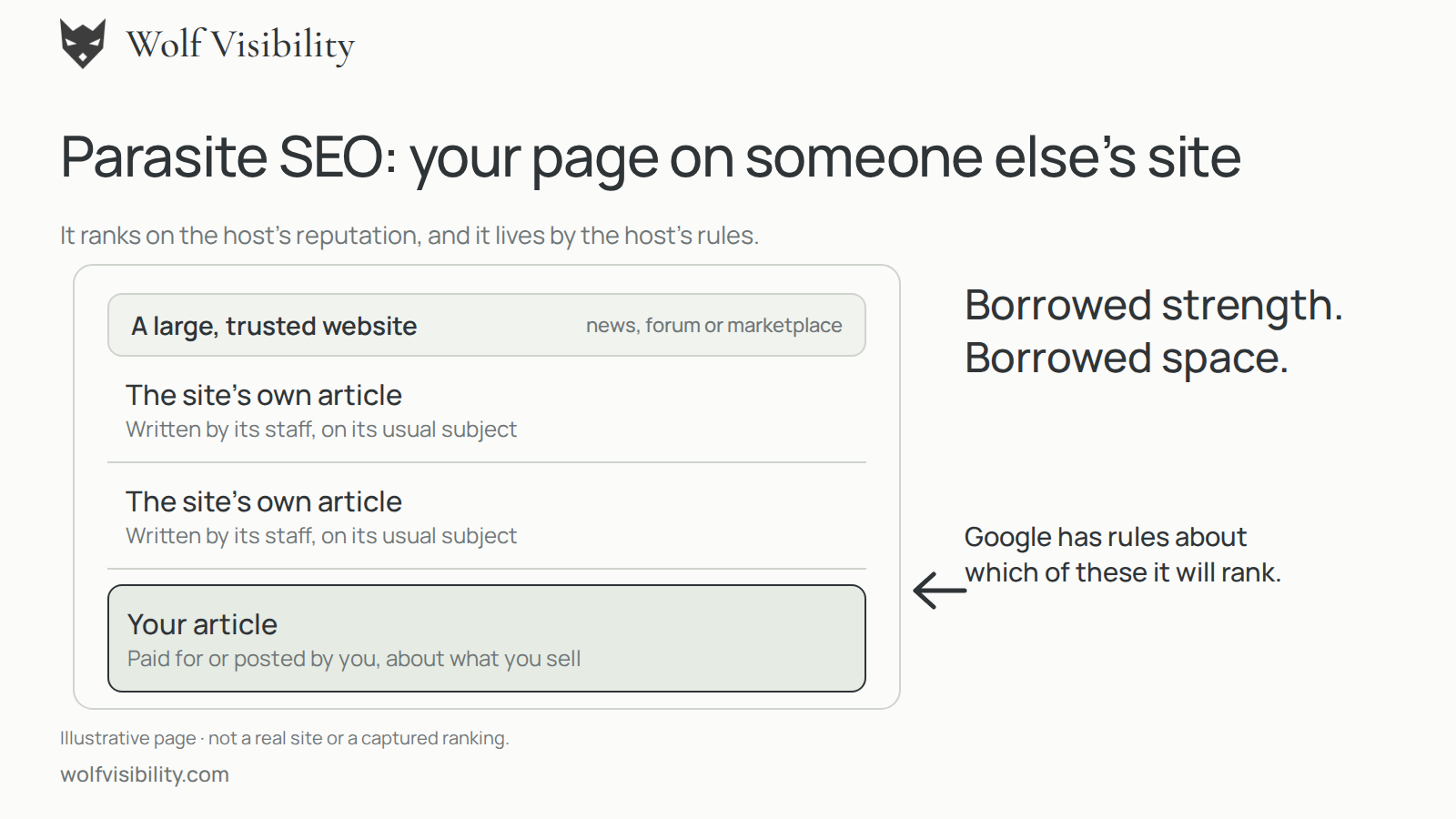
Parasite SEO is publishing a page on someone else’s trusted website, such as a news site, a forum or a marketplace, so that it ranks in Google on that site’s reputation instead of your own. Paying a publisher to host pages made to rank is against Google’s spam rules. Posting useful content under your own name on open platforms such as Reddit, YouTube and LinkedIn is allowed, and for an online store it is worth doing.
In short
- Parasite SEO borrows another site’s reputation to rank a page you could not rank yourself.
- Google treats paid, made-to-rank pages on publisher sites as spam, under a policy enforced since May 2024.
- Posting on open platforms under your own name is allowed. The platform’s rules apply, and you never own the ranking.
- Ask whether the page would be worth publishing if it never ranked. If not, don’t pay for it.
- Build your own pages for the searches your site can win, and use other platforms for the ones it can’t yet.
How does parasite SEO work?
Google trusts some websites more than others. A national newspaper, a university or a large forum has years of links and readers behind it, so a new page on one of those sites can reach the first page in days. The same page on a new store’s own site might take months, or never get there.
Parasite SEO uses that gap. Someone places a page about their product on the trusted site, the page ranks on the host’s reputation, and the visitors click through to the seller. The name comes from the relationship: the page feeds on a reputation it did nothing to build.
It usually happens in one of three ways:
- Paying a publisher for space. A news or magazine site sells a section, or individual articles, to an outside company. “Best protein powders” on a newspaper’s domain, written by a marketing firm, is the classic case.
- Posting on open platforms. Anyone can publish on Reddit, Medium, LinkedIn, Quora or YouTube, and those sites rank well.
- Using forgotten corners of trusted sites. Old subdomains, expired pages and unmoderated profile pages on universities, charities and government sites get filled with unrelated promotions.
Is parasite SEO against Google’s rules?
The first and third kinds are. The second is not, as long as you follow each platform’s own rules.
Google calls the paid-space version “site reputation abuse” and treats it as spam. The policy was announced in March 2024 and enforced from May 2024. In November 2024 Google tightened it: a publisher being involved in, or overseeing, the outside content no longer makes it acceptable. What matters is whether third-party pages are there mainly to rank on the host’s reputation.
The penalty lands on the host. After the November 2024 change, the product-review and coupon sections of several large publishers, including Forbes Advisor, CNN Underscored and the Wall Street Journal’s Buy Side, were widely reported to have lost most of their Google visibility. For the company that paid for a page there, the effect is the same: the page disappears from search, and the money is gone.
Filling abandoned pages on trusted sites is covered by Google’s rules on hacked content and expired-domain abuse. Where it involves breaking into a site, it is also against the law.
| Kind | Google’s position | Main risk to a store |
|---|---|---|
| Paid articles or sections on a publisher’s site, made to rank | Spam (site reputation abuse) | The page is removed from search and the fee is lost |
| Your own posts on Reddit, Medium, LinkedIn, Quora, YouTube | Allowed | The platform can remove the post, and you never own the ranking |
| Pages planted on neglected or hacked sites | Spam, and often illegal | Removal, and legal exposure |
| Clearly labelled advertising that is not built to rank | Allowed | It brings readers, not rankings |
Rules in this area are still moving, particularly in Europe, where regulators have challenged how Google applies the policy to news publishers. Check Google’s current spam policies before paying anyone for placement.
Does parasite SEO still work?
The paid version works until it stops, and nobody tells you when that will be. Agencies still sell it because a page on a strong domain can rank within a week. The question for a store is what that ranking is worth if it can vanish on any day and you cannot move it anywhere.
The open-platform version works well, and it has become a normal part of search. In our October 2026 study of shopping searches across 23 e-commerce verticals, forums, social posts and videos held 22% of first-page results, and buying guides and editorial pages held another 20%. Stores held 55%. Close to half of the first page belongs to somebody other than a store, so being present on those other sites is part of being found.
Should an online store use parasite SEO?
Skip the paid placements. Use the open platforms, honestly and under your own name. That is the part of parasite SEO that is simply good marketing, and some people call it by a gentler name, barnacle SEO.
The test is simple: would the page still be worth publishing if it never ranked? A useful answer on a forum passes. A “10 best” article you paid a newspaper to host does not.
Three examples of the honest version. They are illustrations, not researched figures.
- A skincare store. A shopper asks on a skincare forum whether a sunscreen leaves a white cast on darker skin. The founder answers in detail, says who they are, and explains which filters cause it. The thread ranks for that question for years. Most communities ban plain promotion, so the answer has to be useful first.
- A jewellery brand. A two-minute video, “How to stop gold vermeil tarnishing”, published on the brand’s own YouTube channel. Video results appear on many jewellery searches where a product page would not.
- A supplement brand. A marketplace listing with a complete description, lab results and real reviews. Marketplaces hold much of the first page for supplement searches, so a good listing there is a first-page result you control more than most.
What should you do before any of this?
Find out which of your searches a page on your own site can win. Borrowed rankings are the answer for searches your own site cannot reach yet, not a replacement for the ones it can.
- Search your product the way a shopper would and note what kind of page holds each position: stores, guides, forums, videos or marketplaces.
- Where small stores already rank, build your own page. It is the only ranking you own.
- Where forums and videos rank, take part there under your brand’s name.
- Where marketplaces hold the page, improve your listing before you write anything.
- Where large publishers hold the page, earn a mention with something worth reporting: your own data, a founder’s expertise, a product sent for honest review. Do not buy the page.
Our guide to e-commerce keyword research shows how to read a first page this way, with a real example.
Common questions
What is a parasite SEO example?
A “best mattresses” article on a newspaper’s website that was written and paid for by a marketing company, not the newspaper’s staff. It ranks because of the newspaper’s reputation. A milder example is a brand’s own article on Medium or LinkedIn that ranks for a question its small website could not.
Is parasite SEO black hat?
It depends on the kind. Paying a publisher to host pages built to rank breaks Google’s spam policy, and planting pages on hacked or neglected sites is plainly abusive. Posting useful content under your own name on platforms that invite it is ordinary marketing.
What is the best parasite SEO platform?
For an online store, the one where your shoppers already ask questions. Search your product and see which platforms appear on the first page: often Reddit, YouTube and the large marketplaces. A list of “high authority sites” is less useful than that one search.
Can my own store be penalised for parasite SEO?
Google’s action is normally taken against the page or the hosting site, so your store’s own rankings are not usually the target. You lose the borrowed ranking and whatever you paid for it. Links bought as part of the deal are a separate risk, covered by Google’s rules on link spam.
Is guest posting parasite SEO?
A guest article written for a site’s readers, on the site’s subject, is not. It becomes a problem when the article exists to rank for a buying search or to carry a paid link, and the host publishes many of them without real editorial judgement.
Does parasite SEO work for AI answers from ChatGPT or Gemini?
Assistants draw heavily on forums, video and well-known publishers, so being discussed there helps. The same test applies: honest, useful contributions under your own name last. Planted promotion gets removed by the platform.
When this advice changes
- Your site is brand new. Open platforms can bring your first visitors while your own pages are too new to rank. Start your own pages at the same time, so the borrowed ones are a bridge.
- A publisher offers you a sponsored article. Treat it as advertising. It can be worth buying for the readers it reaches. Do not pay extra for a promise that it will rank or pass link value.
- You already paid for placements. Leave them, but stop counting on them. Move the same topic to a page on your own site, so there is something left if the placement goes.
- You sell in a regulated category. Health, finance and similar products face stricter platform rules and advertising law. Claims you could not make on your own site are not safer on someone else’s.
Note for your developer or agency: sponsored and affiliate links should carry rel="sponsored"; do not rely on cross-domain canonical tags from third-party posts; and track visits from each platform with tagged links so you can tell which placements bring buyers.