
E-commerce keyword research for D2C brands: find the searches that end in a sale
All marketsBy SushmitaUpdated
E-commerce keyword research for a D2C brand comes down to five steps: sort searches by how close they are to a purchase, list the high-intent ones in your buyers’ own words, check whether the pages already ranking are beatable, match each keyword to one page, and put it in the title, address, heading and first sentence. Start with the searches closest to a sale, not the ones with the most volume.
In short
- Start with transactional searches. They are closest to a sale and usually the least contested.
- Draft ideas with an AI assistant, then keep only the phrases your customers, your site search and Google’s suggestions confirm.
- Read the first page before writing. Weak, unfocused or thin results are your opening.
- One keyword, one page. Product and collection pages for buying searches, guides for questions.
- Shoppers don’t search “D2C”. Use the product, the problem or the occasion.
Step 1: Sort keywords by intent, and start nearest the sale
Every search sits somewhere between “I’m curious” and “I’m ready to buy”. Sorting keywords by that intent tells you which ones can pay for themselves.
| Intent | What the shopper wants | Examples |
|---|---|---|
| Informational | To learn something | “how to clean silver jewellery”, “what does niacinamide do” |
| Commercial | To compare options before buying | “best demi-fine jewellery brands”, “vitamin c serum vs niacinamide” |
| Transactional | To buy a specific thing | “gold vermeil hoop earrings”, “fragrance-free moisturiser for oily skin” |
Start at the bottom of that table. A new store has limited time and no reputation with search engines, so spend both on the searches closest to a sale. Informational articles come later, once your product and collection pages are doing their job.
One thing to notice: none of those examples contains the word “D2C”. That is a label the industry uses. Shoppers search for the product, the problem or the occasion.
Step 2: Find high-intent keywords without a paid tool
You want the searches people make when they know their problem, want a solution, and have not yet picked a brand. They are looking for you without knowing your name.
An AI assistant is a quick way to draft that list. Describe what you sell in real detail, then ask for it:
Act as an SEO specialist. This is what I sell: [materials, price range, who it is for, what makes it different, where you ship]. List only the searches people make when they know their problem and want a solution but have not chosen a brand yet.
Treat the answer as a list of ideas. An assistant cannot tell you how often a phrase is searched, and it will sometimes invent phrases nobody types. So check each idea against real buyer language:
- Your own customers. The exact words in support messages, reviews and return reasons.
- Your site search. What visitors type into your store’s search box.
- Google itself. Type the phrase and read the suggestions, “People also ask” and the related searches at the bottom.
- Forums. How people phrase the question on Reddit or in category communities.
Keep the phrases that show up in more than one of these places. Ten good ones are enough to begin.
Step 3: Check whether you can rank for a keyword
Search the phrase and read the first page before you write a word. You are looking for signs that the current results are weak. Each of these is a point in your favour:
- The ranking pages don’t use the phrase. Look at each result’s title, web address, main heading and description. If most of them only half-match the search, nobody has written a page aimed at it.
- The sites are no stronger than yours. SEO tools give every site an authority score. These are estimates made by the tool companies, not numbers Google uses, but they are a fair way to compare. Small sites on page one mean a small site can get there.
- The pages rank by accident. If a result is really about something else and only mentions your topic in passing, a page focused on the question can beat it.
- The content is thin. Short pages that don’t answer the question, old pages, and pages with no detail a buyer could decide from.
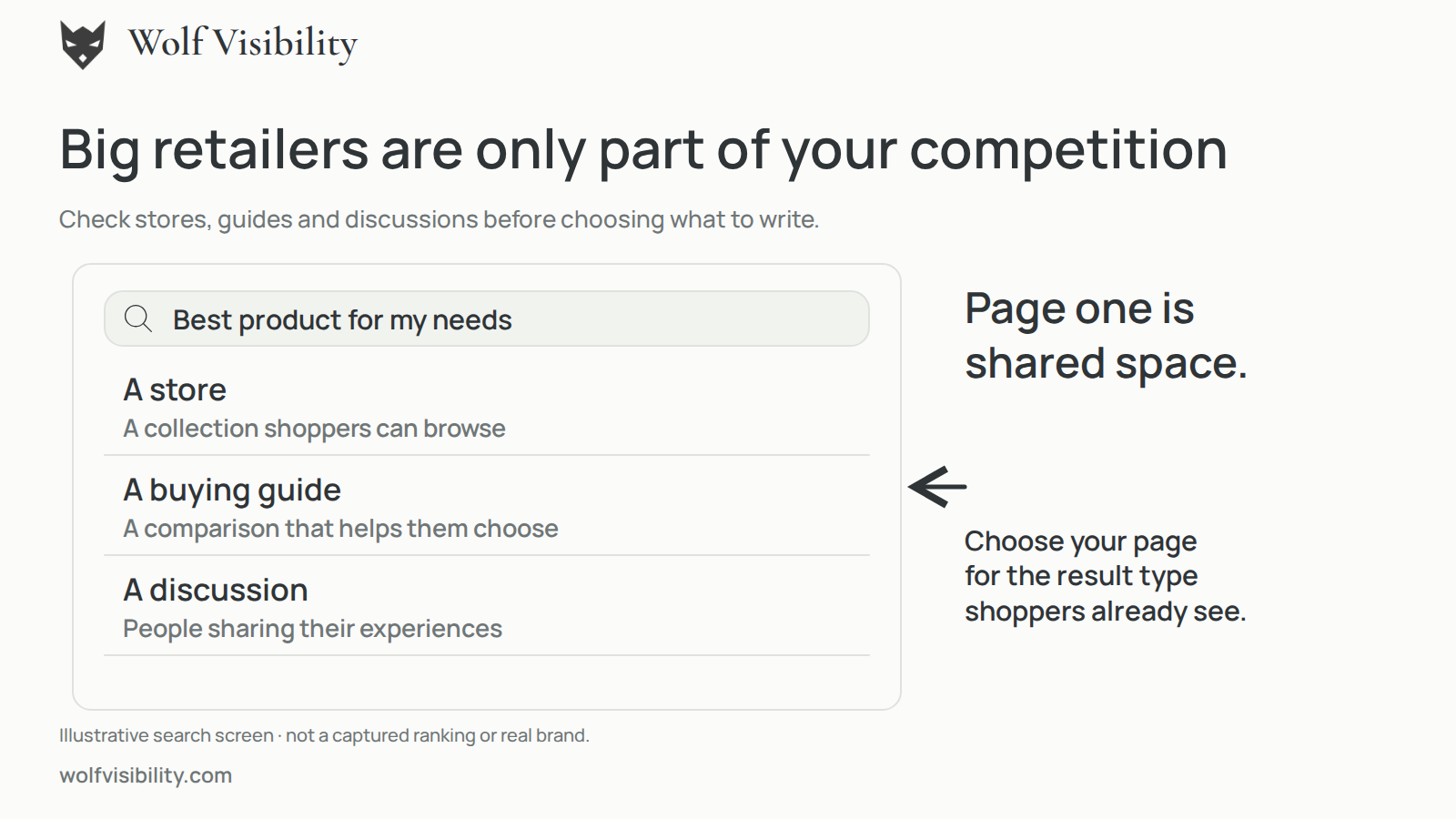
- Stores are allowed on the page. Check what kind of result ranks: stores, buying guides, forums or marketplaces. If the page is all guides and videos, a product page will struggle and a guide is the better bet.
That last check matters more than most guides admit. In our October 2026 study of shopping searches across 23 e-commerce verticals, stores held only 55% of first-page results. Buying guides and editorial pages took 20%, and forums, social and video took 22%. Stores held 62% in India and 48% in the United States.
A keyword with three or more of these signs is worth a page. A keyword with none, where large retailers hold every position with focused, detailed pages, is one to leave for later.
Step 4: Match each keyword to one page
Give each keyword one page, and each page one main keyword.
| Keyword type | Page that should target it |
|---|---|
| Transactional, one product | Product page |
| Transactional, a group of products | Collection page |
| Commercial (best, vs, review) | Buying guide or comparison, linking to the collection |
| Informational (how, what, why) | Short guide, linking to the product that solves it |
Two pages aimed at the same keyword compete with each other, and usually neither wins. If you already have two, combine them or make one clearly about something else.
Step 5: Put the keyword where it counts on the page
Once you have chosen a keyword, put it where both shoppers and search engines look first:
- The page title
- The meta description
- The web address
- The main heading
- The first sentence
Use the shopper’s words, but don’t force the exact phrase. In the same study, 85% of ranking page titles contained at least half the words of the search, yet only 40% contained all of them, and 75% included the brand name. Titles on ranking collection pages had a median length of 56 characters. A clear title that reads naturally and covers the main words is what the ranking pages actually have.
What does keyword research look like for one brand?
Take a small brand selling gold vermeil jewellery. These phrases are illustrations of the method, not researched figures.
- Draft. The assistant suggests “gold vermeil hoop earrings”, “hypoallergenic gold earrings”, “gold jewellery that doesn’t tarnish” and “best demi-fine jewellery brands”.
- Check the language. Reviews keep mentioning sensitive ears, and Google suggests “hypoallergenic” after “gold earrings”. That phrase stays.
- Read the first page. For “hypoallergenic gold earrings”, suppose the results are mostly large marketplaces with generic listing pages and one thin article. That is three weak signs.
- Pick the page. It is a group of products, so it belongs on a collection page.
- Place it. The collection is titled “Hypoallergenic Gold Earrings”, opens with a sentence on who they suit and why, and states the metal and plating thickness where a shopper can see them.
“Best demi-fine jewellery brands” goes on a separate list for later. It needs a comparison guide, and a brand ranking itself first is not convincing.
What does real keyword research find? A sunscreen example
Here is the same method run with real data. The brief was a fragrance-free SPF 50 sunscreen for oily and sensitive skin, sold by a new store in India. We measured 1,000 Google searches that contain “sunscreen”, removed the ones a new store cannot use, and read the first page for the eight most promising.
Most of the list had to go: 434 searches named another brand, 253 were rewordings of a search already on the list, and 32 were for a different product, such as a sun-protection jacket. That left 281.
The best opportunity was not the biggest search. It was “sunscreen for oily and sensitive skin”, with 880 searches a month. Only 2 of the 8 pages on Google’s first page used those words in their title, and three of the ranking sites were small. A product page titled “Sunscreen for Oily and Sensitive Skin SPF 50” has a fair chance there. “Sunscreen for combination skin” gets far more searches, but every page ranking for it is already built around that exact phrase.
| Search | Searches | What to do |
|---|---|---|
| Sunscreen for oily and sensitive skin | 880/mo | Do now |
| How to use sunscreen | 3,600/mo | Write this article |
| Lightweight sunscreen for oily skin | 3,600/mo | Consider next |
| Facial sunscreen for sensitive skin | 880/mo | Consider next |
| Sunscreen face cream | 6,600/mo | Build toward: large marketplaces hold most of the first page. |
| Sunscreen combination skin | 14,800/mo | Build toward: established pages already target this search directly. |
| Sunscreen oily skin SPF 50 | 8,100/mo | Build toward: large marketplaces hold most of the first page. |
| Sunscreen gel SPF 50 | 2,900/mo | Build toward: large marketplaces hold most of the first page. |
That is the whole point of the research: a short list of pages to build, and a longer list of tempting searches to leave alone. Read the full sample report, written once for store owners and once for SEO specialists, with all the data behind it.
Common questions
How many keywords should a new D2C store target?
Start with about ten, one for each page that matters most. Ten pages that each answer one search well will do more than a hundred keywords scattered across thin pages.
Do I need a paid keyword research tool?
Not to begin. Your customers’ words, your site search and Google’s own suggestions are enough for a first list. A paid tool becomes useful later, for search volumes and for comparing your site’s strength with the sites that rank.
Does search volume matter?
Less than intent. A phrase searched a few dozen times a month by people ready to buy can be worth more than a broad term searched thousands of times. Tools also report zero for many long, specific phrases that people do search.
Should I put “D2C” in my keywords?
No. It is an industry term, and shoppers don’t use it. They search for the product, such as “gold vermeil hoop earrings”, or the problem, such as “earrings for sensitive ears”.
Can you do the keyword research for me?
Yes. For $10 (₹849 in India) we research one product in one market and email you a report within 30 to 90 minutes: the pages worth building first, a title and web address for each, and the searches to leave alone. The order form is at the end of this guide, next to a real sample report.
Do keywords still matter now that people ask ChatGPT and Gemini?
Yes, though the questions get longer. People ask assistants in full sentences, and assistants draw on pages that state plainly what a product is and who it suits. A page built around one clear buyer question serves both.
When this advice changes
- Your product is a new kind of thing. If nobody searches for the category yet, there are no keywords to capture. Target the problem it solves, and expect to build demand through other channels first.
- Marketplaces hold the whole first page. When every result is Amazon or another marketplace, a small store’s product page rarely breaks in. Go one step more specific, or answer the question with a guide.
- Your site is brand new. Choose the longest, most specific phrases first. They have fewer strong competitors, and early wins on them help the broader pages later.
- Your category is seasonal. Search interest for gifting and festive products moves with the calendar. Publish the page well before the season, not during it.
Done for you · $10 per report
Get this research done for your product.
Tell us what you sell. We research Google for one product in one market and email your report within 30 to 90 minutes.
- The 3 or 4 pages worth building first, in priority order
- A title, web address and the questions to answer for each page
- The bigger searches to build toward, and what each needs first
- Every search we measured, for you or your SEO person to check
Note for your developer or agency: check for existing pages that already target a chosen keyword before adding a new one, give each target page a unique title and meta description and a self-referencing canonical, and keep faceted or filtered collection URLs from competing with the main collection page.